Book Categories:


Cultural, Literature
How to Memorize Faster: Best Techniques To Boost Your Grades

December 16, 2025
Share:
Share:
How to memorize faster is a query that has gained more focus as people look for efficient ways to maximize their learning and increase their information retention ability. In a world that continues to evolve new information every second, qualities and capabilities like faster memorization and easy recall skills are a strong asset for anyone. Whether you’re studying for tests, learning a new language, or attempting to recall names at a networking function, effective memory is a game-changer. But is there a magic formula for increasing memory speed? Thankfully, science and experience indicate there is. From evidence-based strategies and methods geared toward speeding up memorization, such as visualization, chunking, spaced repetition, mnemonics, etc., to daily habits such as sleep, diet, and so on, there exist actionable strategies that can improve how fast and how well you memorize. In this blog, we’ll explore proven methods to help you train your brain how to memorize faster and smarter, systematically and sustainably.
By the end of this blog you will find the answers to some of the most commonly asked questions like:
How to memorize faster and not forget
How to memorize faster in one day
How to memorize faster for exams
How to memorize faster and for a longer time
How to memorize faster for students
How to memorize a long answer faster
how to memorize faster
Memory and Memorization
Two often confusing terms which may seem to have the same meaning but it’s not so. They have completely different meanings. Let’s understand their differences to have a clear idea.
In simple terms, memory is your brain’s capacity to collect, process, store, and recall information. This mechanism enables you to retain experiences, facts, skills, and knowledge so you can use them in the future. It also enables you to recall the past, recognize familiar things, learn new skills, and understand what’s happening around you.
Memory is a complex process where different stages and various regions of the brain work in simultaneous coordination.
You should remember that our brain is not a camera that records every moment with minute details. With time memories can become weak, distorted, and can even disappear. But it’s this amazing ability to learn from the past that makes us what we are and how we understand the world.
Conversely, memorization is the active, conscious process of encoding information into your memory to be stored and easily retrieved when required. It’s the intentional effort you put in to learn and remember certain facts, details, procedures, or skills. As your brain continues to absorb information passively during the whole day, memorization involves applying certain techniques and strategies in order to memorize that information.
In a nutshell, memory is the system as a whole of storing and recalling information, whereas memorization is the conscious series of steps you perform to make that storage and recall more effective and efficient. It’s the step between learning something new and having the ability to recall it when you need to.
how to memorize faster
Know Your Brain and Understand How It Works
Understanding the way how memory functions is important to know when finding the solution of how to memorize faster. Memory is not a single storage cabinet inside our head; rather, it’s a complex system of various systems that deal with different kinds of information and retain it for varied lengths of time. From the short sensory memories that are temporary for a few seconds to the long-term memories that can linger with us for years, our brain is always processing and storing information. Memory booster techniques are basically strategies that assist us in traversing this complex system, facilitating the process of encoding, storing, and recalling information to be more efficient and effective. Therefore, as we explore further into the realm of faster memorization, remember that we’re not just learning tricks; we’re learning and refining one of the most powerful tools we have – our own memory.
Understanding these fundamental aspects of your brain and how it processes memory empowers you to adopt more effective learning and memorization strategies, ultimately leading to faster and more efficient recall. You’re essentially working with your brain’s natural mechanisms rather than against them.
Misconceptions or Myths about Memorization
Let’s discuss some common yet widespread misconceptions or myths about memorization:
Rote memorization is optimum: There is an age-old belief that rote memorization is one of the best memorization methods. Although there is a place for repetition, but continuously repeating and roting layers of information over and over without understanding is ineffective for long time memorization.
Memory cannot be improved: Memory is not a fixed quality. Like any other skill, it can be developed and mastered with regular practice and the application of effective techniques.
Memorizing is only storing information: Memorization is not merely overloading facts into your head. It also includes structuring, relating, and understanding the information so that it is easier to recall and apply.
Forgetting is the loss of memory forever: Forgetting is not always permanent. Memories can be unavailable due to interference or lack of retrieval cues, but they may still exist in the brain and be retrieved under the right conditions.
Understanding something is memorizing it automatically: Although understanding facilitates memorization, but does not assure it. You must still be actively working with the information and applying techniques to retain it.
Adults cannot enhance their memory: Although memory may change with age, adults can still improve their memorization abilities by employing the correct methods and practicing mentally stimulating exercises.
By knowing and disproving these myths, you can proceed with memorization with more realistic approach and employ effective methods to increase your capacity to learn and remember faster.
how to memorize faster
How To Memorize Faster?
In this section you will get to know how to memorize faster using a combined wholesome approach with best memory booster techniques and methods. To effectively become proficient in faster memorization it’s crucial to understand the process, including brain functions, useful techniques, lifestyle aspects, and techniques to overcome everyday challenges. Now let’s discuss in detail how to memorize faster:
Understanding the Basis of Memory
The Stages of Memory
Sensory Memory: It is the initial stage of memory which briefly retains a huge amount of sensory information (information perceived through our 5 senses) from the surroundings for an extremely brief time (milliseconds to seconds). For example, casually noticing the color of a car that passed by before you focus on something else is your sensory memory in action.
Short-Term Memory (Working Memory): Temporary storage holding capacity with limited information currently being utilized. Recall of a telephone number long enough to dial it is an example of short-term memory.
Long-Term Memory (LTM): It stores various types of information for a longer period of time ranging from months, and years to a lifetime. It can be referred to as permanent storage. Types of LTM:
Explicit (Declarative) Memory: Intentional recollection of facts and events.
Semantic Memory: General knowledge, facts, and concepts.
Episodic Memory: Everyday experiences and events based on time and place.
Implicit (Non-Declarative) Memory: Automatic recall of skills and habits.
Procedural Memory: Knowing how to perform certain actions and skills (motor skills).
Priming: Presenting a stimulus that later influences response.
Classical Conditioning: Acquired connections between stimuli.
how to memorize faster
The Science of Faster Memorization: Effective Techniques
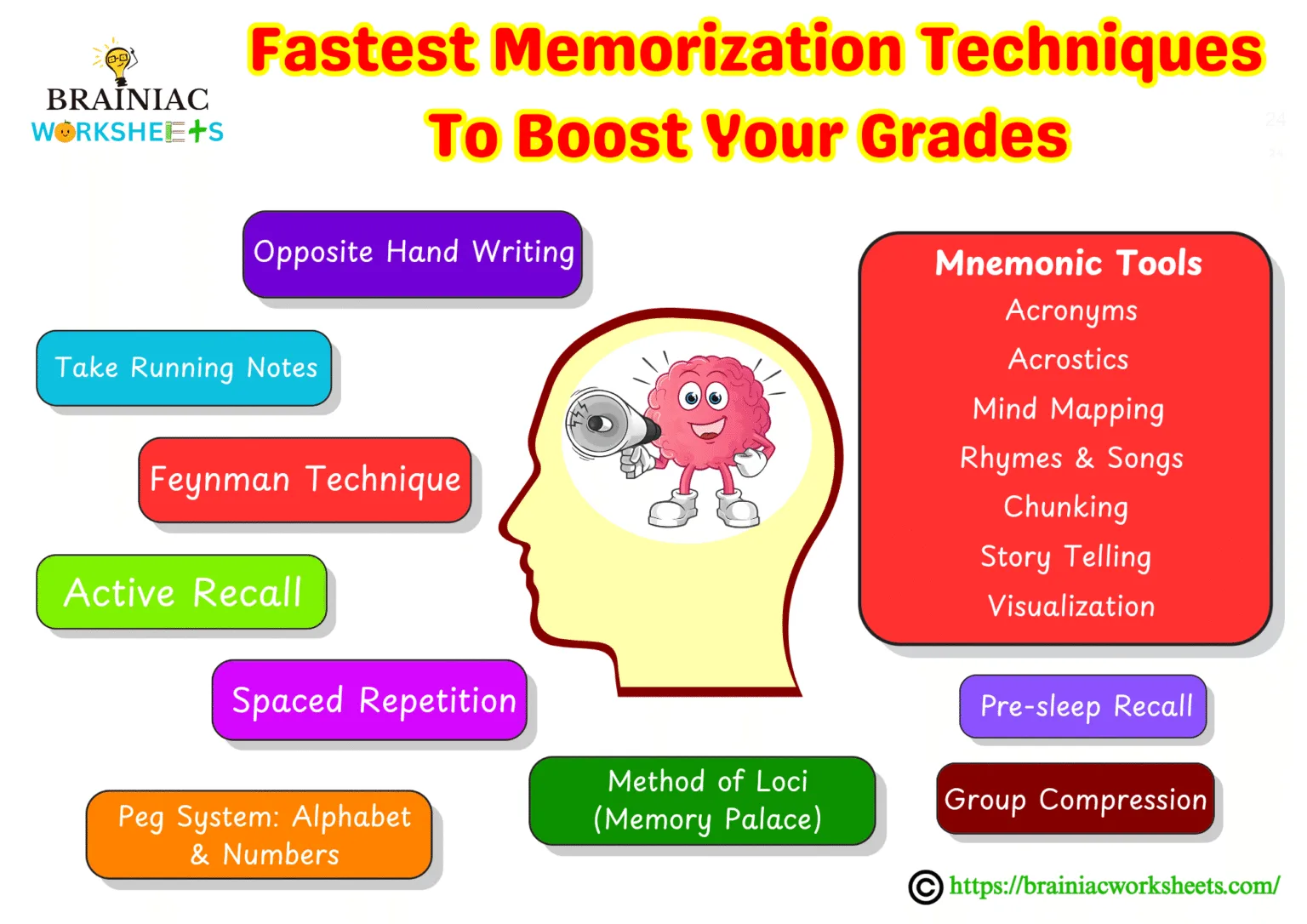
Pomodoro Technique
This is a time management technique invented by Francesco Cirillo. The first step to find the solution of the question of how to memorize faster is to understand how to manage your time while learning and use it effectively. The Pomodoro technique is a study cycle where you study for 25 minutes and take a break of 5 minutes. Repeat this 4 times and then take a 30-minute long break. These 2 hours make one cycle. If you repeat 4 cycles like this daily, you will start observing remarkable improvements. Make sure to choose an undistracted place to study, turn your phone into flight mode, set an alarm for 25 minutes, and tell everyone not to disturb you during this time; you can also use DND boards instead.
Note: Don’t use your mobile phones during the 5-minute breaks, instead, you can take a nature walk or have a conversation with your family.
how to memorize faster
The “Opposite Hand Writing” Method
Try this unique trick if you want to memorize something instantly. If you are right-handed, write with your left hand and vice versa. When you get out of your comfort zone, your brain has to focus more to get the job done. Attempt writing a math equation 10 times that you believe is difficult to recall using this method. This trick works only to memorize brief information like spellings, formulas, equations, and scientific names; not for long answers. Comment below if it worked for you or not.
how to memorize faster
Take Running Notes
This turns passive listening into active participation, where your hands are writing down the necessary points. This exercise naturally pulls your attention in the subject because your ears, brain, and hands are all connected and actively participating in this exercise. Always keep in mind, writing down whatever subject you have learned makes the concept clear and helps you to memorize faster.
how to memorize faster
Feynman Technique
This technique was developed by Richard Feynman, who says to try explaining a tricky or complex concept in simple terms to someone younger than you, as if you are teaching it to a child. If you are unable to simplify a concept at this level, identify your learning gaps and repeat the same until you are successful. When you simplify complex ideas, you strengthen your understanding and empower your memory.
how to memorize faster
Active Recall
Try recalling information from memory without referring to notes. This strengthens the retrieval track making it smoother and accessible. Through self-testing quizzes, flashcards, and self QnA sessions, you can assess yourself and find out your learning gaps which will encourage you to dive much deeper into the topic. For example, after reading a chapter, try to answer the end-of-chapter questions without looking at the text.
how to memorize faster
Spaced Repetition
This is also a time management technique like the Pomodoro. Revise study materials (books, notes) frequently but not continuously to prevent forgetting. This gives time to our brain for processing the information to be remembered for a long time. Periodic revision reinforces memory. Employing Spaced Repetition Software (SRS) such as Anki, making your own review schedule, and reviewing notes at increasingly longer intervals (e.g., after 1 hour, 1 day, 3 days, 1 week, etc.). You can also use the 7-3-2-1 spaced repetition study method which means study today (1), revise tomorrow (2), day after tomorrow (3), and on the seventh day (7). Repeat this cycle as required.
how to memorize faster